Bitmain Antminer L3
|
ASIC Model series:
|
ASIC Release: |
Hashrate:
|
ASIC Power:
|
|
ASIC Algo:
|
 Bitmain Antminer L3++ Bitmain Antminer L3++ |
May 2018 |
580 Mh/s
596 Mh/s |
942W
1050W |
  |
Scrypt
|
|
Bitmain Antminer L3+ |
Oct 2017 |
600 Mh/s
504 Mh/s |
850W
800W |
|
Scrypt
|
Modified ASIC Firmware for Antminer L3 series (all types)
(15-25% improvement) download here
Bitmain Antminer L3 ASIC Miner
The Bitmain Antminer L3 is one of the earliest and most widely recognized Scrypt ASIC miners, representing the first generation of machines capable of competing with GPUs for Litecoin (LTC) and Dogecoin (DOGE) mining. Its release marked the beginning of full ASIC dominance in the Scrypt ecosystem, paving the way for later models like the L7.
This article provides a comprehensive technical overview of the Antminer L3, consolidating all versions into a single operational range, along with insights from user communities, real-world performance reports, and optimization strategies using custom firmware, overclocking, and undervolting.
Scrypt Algorithm
Scrypt is a memory-intensive Proof-of-Work algorithm originally designed to resist early ASIC development by requiring large amounts of RAM per thread. Despite this, the L3 and subsequent Scrypt ASICs fully eclipsed GPU mining performance. Today, Scrypt mining is almost entirely ASIC-driven, with the L3 often serving as a historical benchmark for early-generation Scrypt mining hardware.

Bitmain Antminer L3
The Antminer L3 is a dedicated Scrypt ASIC miner built for high-efficiency Litecoin and Dogecoin mining. Unlike later models, the L3 introduced miners to practical ASIC operation for Scrypt, combining moderate power consumption with stable hash performance.
All L3 units share the same architecture, and differences between models such as L3, L3+, and L3++ are primarily the result of chip binning and factory frequency settings, rather than fundamentally different hardware. This allows the Antminer L3 family to be accurately described as a single platform with operational ranges.
Coins Mined With ASIC Antminer L3
The Antminer L3 supports the full Scrypt ecosystem. Its primary mining targets are:
-
Litecoin (LTC)
-
Dogecoin (DOGE) via merged mining
-
Digibyte (DGB – Scrypt)
-
Viacoin (VIA)
Merged mining enables users to earn LTC and DOGE simultaneously, which was a significant advantage even in the early L3 era.
Antminer L3 (All Variants)
Rather than treating the L3, L3+, and L3++ as separate units, it is more practical to consider operational ranges across the family.
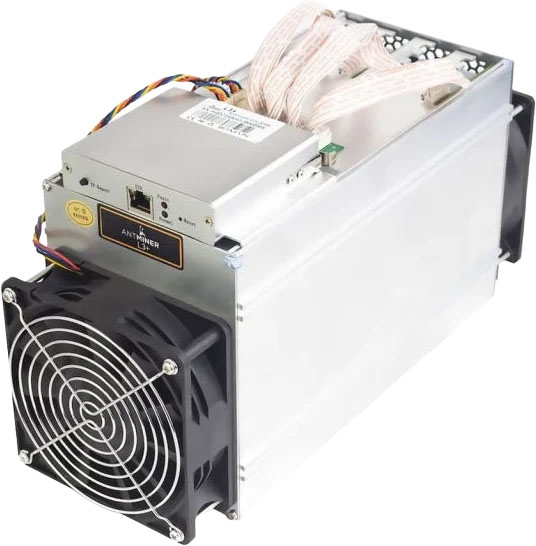
Bitmain Antminer L3 ASIC
-
Algorithm: Scrypt
-
Hashrate Range: approximately 336 MH/s to 504 MH/s
-
Power Consumption Range: ~360 W to ~800 W
-
Energy Efficiency: ~1.1–1.6 J/MH
-
Release Period: 2014–2016
-
Cooling System: Dual fans, moderate airflow
-
Noise Level: ~55–60 dB for early L3; slightly higher for L3+
-
Input Voltage: 11.6–13.0 V (via PSU)
-
Network Connection: Ethernet
-
Operating Temperature: 0–40 °C
While the L3 cannot compete with modern L7s, it remains a historically significant ASIC, and many units still circulate in secondary markets for enthusiasts or collectors.
Heat Output Antminer L3
Even the original L3, despite its lower power draw compared to later models, generates significant heat during continuous operation. Users often report that sustained operation in enclosed or poorly ventilated rooms can lead to throttling. Many miners used external fans or dedicated cooling shelves to maintain stable temperatures. Power stability is also critical; sudden voltage fluctuations could cause reboots or hashboard errors.
Real User Experiences Antminer L3
Across Bitcointalk, Reddit, and Telegram, miners often discuss the L3’s reliability and ease of use. Many early adopters praise its plug-and-play nature, with minimal tuning required to reach near-stock performance. Users consistently mention low hashboard failure rates and predictable revenue in early Litecoin and Dogecoin mining days.
However, feedback also highlights limitations. The L3’s profitability is strongly tied to coin price, and electricity costs had to be very low for consistent ROI. Noise, while moderate compared to L7, was still an issue for home users, especially when operating multiple units in the same room.
Custom Firmware for the ASIC Bitmain Antminer L3
Community-driven custom firmware for the L3 family allows miners to adjust clock speeds, voltages, and fan behavior. Many users report that firmware updates can unlock 10–15% additional hash performance and reduce power consumption. Popular firmware solutions include VNish and alternative OEM-tuned builds, which also provide improved monitoring and remote management features.
Overclocking ASIC Antminer L3
Overclocking is a common practice among experienced L3 owners. Users often push hashboards to higher clock rates, achieving 10–20% extra hashrate. This comes at the cost of increased power draw and heat generation, so effective cooling is crucial. Community discussions emphasize that moderate overclocking combined with undervolting often yields the best balance of performance and efficiency.
Antminer L3 Undervolting and Efficiency Optimization
Many L3 operators find that undervolting the machine slightly below stock settings can significantly improve energy efficiency while maintaining most of the hash rate. This reduces fan speeds, lowers operational noise, and extends the lifespan of the hashboards. Long-term users often report that undervolting extends hardware life by reducing thermal stress on chips.

Firmware Risks and Warranty Considerations
Users consistently note that installing custom firmware can void Bitmain warranties. Nevertheless, for machines no longer under warranty, or for miners prioritizing efficiency, the benefits outweigh the risks. Experienced miners emphasize cautious tuning and monitoring to prevent damage to hashboards or controllers.
Longevity, Repairs, and Secondary Market Value
Despite being an early-generation ASIC, the L3 still maintains collector and enthusiast interest. Spare parts, replacement hashboards, and community knowledge are widely available, allowing extended use. While it cannot compete with modern L7 or newer Scrypt ASICs in profitability, the L3 remains a functional machine for low-cost electricity setups or hobby mining.
The Bitmain Antminer L3 introduced the era of practical Scrypt ASIC mining, and its legacy continues today. By consolidating all versions into a single platform range, it is clear that the L3 family is defined more by tuning and firmware than by model distinctions. For users with access to low-cost power and proper cooling, the L3 still offers educational value, hobbyist mining opportunities, and insights into the evolution of ASIC technology.